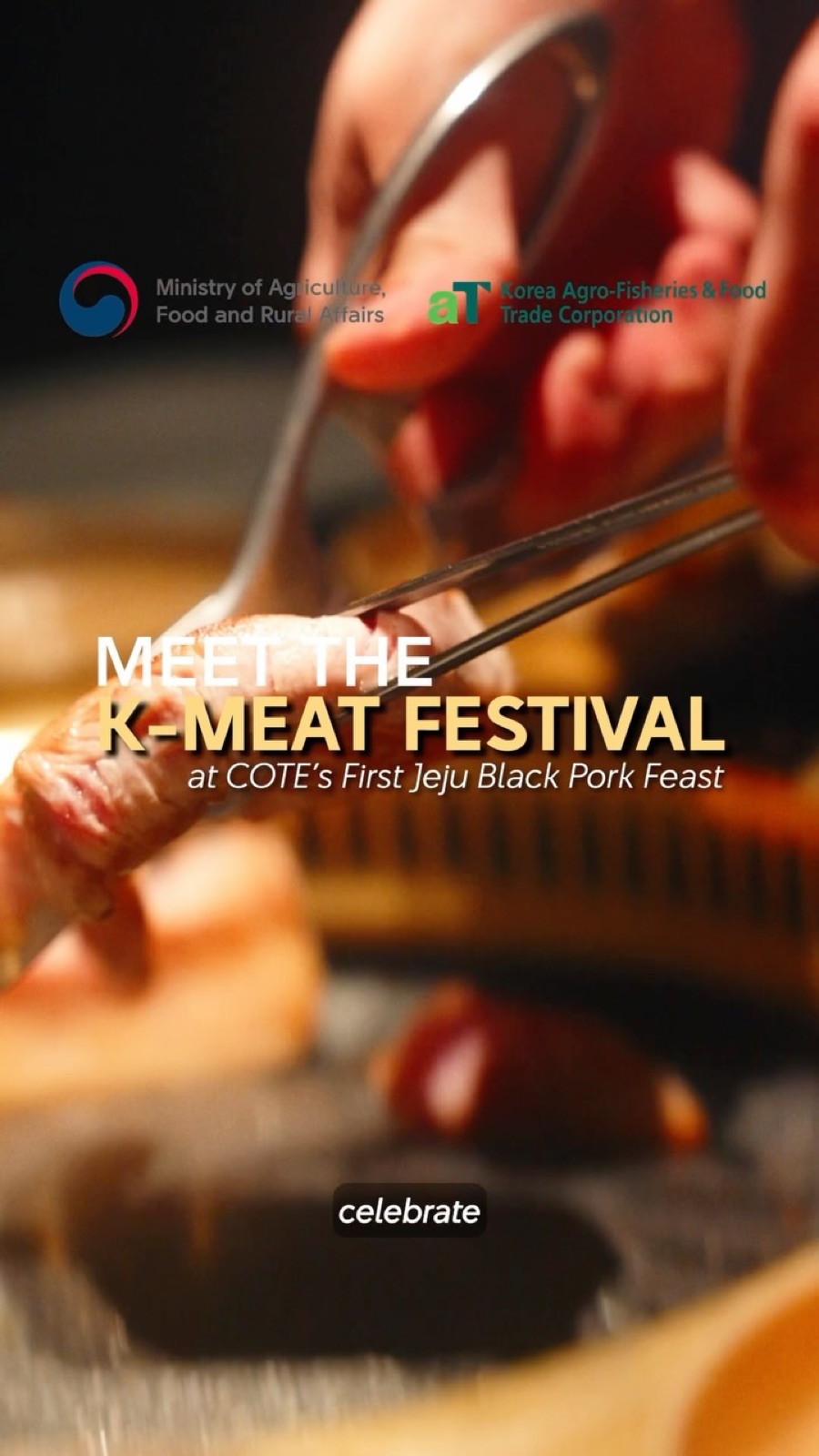
COTE Singapore has replaced its usual beef focus with a limited Jeju black pork menu for the Meet the K-Meat Festival. Available until 31 August 2026 while daily portions last, the showcase is less about placing three cuts of pork on a grill and more about showing how ageing, fat distribution, slicing and marination change each bite.
The restaurant is the first international outpost of the Michelin-starred Korean steakhouse from the United States. For this event, it is serving its first Jeju Handon showcase across the COTE brand. The festival is sponsored by Korea’s Ministry of Agriculture, Food and Rural Affairs and aT, the Korea Agro-Fisheries & Food Trade Corporation, in partnership with MeatK.
What Makes the Jeju Black Pork Menu Different?
The menu approaches Jeju black pork through several preparations rather than treating every cut the same way. The bone-in pork loin is aged, the pork belly is flower-cut, and the pork galbi arrives already marinated. That sequence creates clear changes in texture and flavour across the grill.
This is not simply three cuts of pork placed on a grill. Each cut is aged, sliced or seasoned differently, so the textures change throughout the meal.
The accompanying banchan establishes the balance early. Its sweet and sour flavours cut through the richness of the pork, making it useful between the leaner and fattier bites rather than functioning as a decorative side.
That balance matters because the menu keeps returning to pork in increasingly rich forms. The banchan creates a reset before the next comparison, while the sauces are matched selectively rather than applied to every cut. The result is a tasting sequence in which the preparation of the meat remains legible from one course to the next.
How Does the Aged Bone-In Pork Loin Taste?
The first grilled cut is a 14-day aged bone-in pork loin. It is divided into lean and fatty portions, allowing the same loin to produce two noticeably different textures.
Both portions are juicy. The leaner pieces show the structure of the loin, while the fattier pieces have a richer texture that comes close to pork belly. Eating the pork with ssam and the sweet-sour banchan adds contrast without obscuring the difference between the two sections.
That separation is the useful detail. Instead of presenting the loin as one uniform cut, COTE lets the diner compare how the fat changes the same piece of Jeju pork. It turns the first grill course into a direct texture comparison.
The loin also establishes the logic for everything that follows. The meal does not ask whether one cut is universally better. It shows how the lean and fatty sections answer different preferences, then moves to a pork belly preparation designed around crisp edges and a chewy centre.
Why Is the Flower-Cut Pork Belly Memorable?
The flower-cut Jeju black pork belly has the most distinctive presentation. The slicing creates more edges that can crisp on the grill while keeping the centre juicy and pleasantly chewy.
That combination is the point of the cut. The exterior gains crispness, but the middle retains enough moisture and resistance to keep the pork belly from becoming a flat, uniformly soft bite.
The savoury myeoljeot anchovy sauce is the best pairing for the flower-cut belly. It reinforces the Korean character of the grilled pork and works particularly well with the belly’s fat and chew.
Is the Marinated Pork Galbi Too Sweet?
The marinated pork galbi is sweet, savoury and flavourful enough to eat without another sauce. It follows two cuts whose differences are driven mainly by ageing, fat and slicing, so the marinade gives this course a separate identity.
There is no need to pile on condiments because the galbi carries enough flavour on its own. That keeps the sequence from becoming a repetitive exercise in dipping every cut into the same sauce.
The progression is coherent: compare lean and fatty loin, move to flower-cut belly with crisp edges, and finish the grilled portion with pork galbi whose seasoning is already built in.
That order gives each pork course a clear role. The loin is about contrast within one cut, the belly is about the effect of flower-cut slicing, and the galbi is about a marinade strong enough to stand alone. The distinctions are simple, but they stop the grill from feeling like three variations of the same bite.
What Should You Not Miss Beyond the Grill?
Do not overlook the dombae guksu. It was the surprise favourite of the meal, combining tender pork, noodles and a deeply comforting broth.
It has the comfort of gukbap, but with noodles carrying the dish instead of rice. After several rich grilled cuts, the broth changes both texture and pace.
The dombae guksu is also the strongest reason not to treat the showcase as only a meat platter. It gives the meal a comforting bowl at the end and leaves a more complete impression than the grill courses could provide by themselves.
Its place in the sequence is important. The noodles and broth arrive after the pork-focused grill, but the tender meat keeps the bowl connected to the event’s central ingredient. It is not a departure from the showcase. It is a quieter final expression of the same Jeju pork theme.
For more Korean restaurant coverage, see the Hansang reviews of Na Oh at HMGICS and Wonderful Bapsang at Suntec City.
How Does Dessert Finish the Meal?
Vanilla ice cream with soy-sauce caramel closes the menu. The combination keeps a savoury Korean pantry note in the final course while still functioning as a straightforward cold dessert.
The appeal is the contrast itself: cold vanilla ice cream followed by the salty-sweet depth of soy-sauce caramel.
It is a compact ending after the aged loin, pork belly, marinated galbi and noodle soup. The meal finishes with another familiar ingredient used in a less expected role.
Is COTE’s Jeju Black Pork Showcase Worth Visiting?
Yes, if you want to compare how different preparations change Jeju black pork. The strongest part of the menu is the progression rather than one isolated grilled cut: aged loin split into lean and fatty sections, flower-cut belly with crisp edges, and marinated galbi that needs no extra sauce.
The dombae guksu is the dish not to miss. Its tender pork, noodles and comforting broth made it the surprise favourite, even within a meal marketed around the grill.
COTE Singapore is on Level 3 of COMO Orchard at 30 Bideford Road, Singapore 229922. The Jeju Handon showcase runs until 31 August 2026, with limited portions available daily during the Meet the K-Meat Festival period. Go while the event is running, and approach the menu as a study in how ageing, cutting and seasoning shape each pork course.
FAQ
How long is the Jeju black pork menu available?
The showcase is available until 31 August 2026 while daily portions last.
Where is COTE Singapore?
COTE Singapore is on Level 3 of COMO Orchard, 30 Bideford Road, Singapore 229922.
Which dish was the surprise favourite?
The dombae guksu was the surprise favourite, with tender pork, noodles and a deeply comforting broth.
What are the main Jeju pork preparations?
The menu includes 14-day aged bone-in pork loin divided into lean and fatty cuts, flower-cut Jeju black pork belly, and marinated pork galbi.